Buying or renting batteries for construction sites - Complete guide + TCO

Buy or rent a battery for the construction site?
A sober comparison for contractors who cannot risk downtime
The electrification of construction sites is no longer a thing of the future. It is now a reality.
More and more contractors are replacing diesel generators with battery systems for tower cranes, site villages, and electric machinery.
But as soon as that step becomes concrete, the same question almost always follows:
Should we buy or rent such a battery?
The answer is not black and white.
It depends on project duration, repeatability, risk, degree of organization, and cost structure.
In this article, we explain it clearly, without marketing jargon, using practical logic.
Why this question is relevant today
The classic situation on the construction site:
- Limited or slow network connection
- High diesel costs + maintenance
- Noise pollution (especially in urban areas)
- Downtime = direct failure costs
- Pressure from CO₂ targets and tenders
Battery systems solve this problem.
Not as a "green gadget," but as a reliable power source that absorbs peaks and guarantees continuity.
The only question is: how do you organize that in a smart way?
Option 1
Renting a battery: flexibility without investment pressure
When renting makes sense
Renting is particularly interesting when:
- These are temporary or one-off projects.
- You want to test without internal procedures
- You want to switch quickly (inner-city construction sites, urgent projects)
- The battery must remain project-specific
For many contractors, renting is the first step toward emission-free construction.
Advantages of renting
- No capital investment
- No balance sheet impact
- Service, monitoring, and support included
- Clear cost per month or per project
You're not buying technology, you're buying certainty.
Points to consider when renting
- On long-term projects, renting becomes more expensive than buying.
- Less flexibility when reusing on other sites
- Subject to availability at rental partners
Renting is ideal for getting started without risk, but it is not always the cheapest option in the long run.
Option 2
Buying a battery: control and lower TCO
When buying makes sense
Buying is interesting as soon as:
- You electrify multiple projects per year
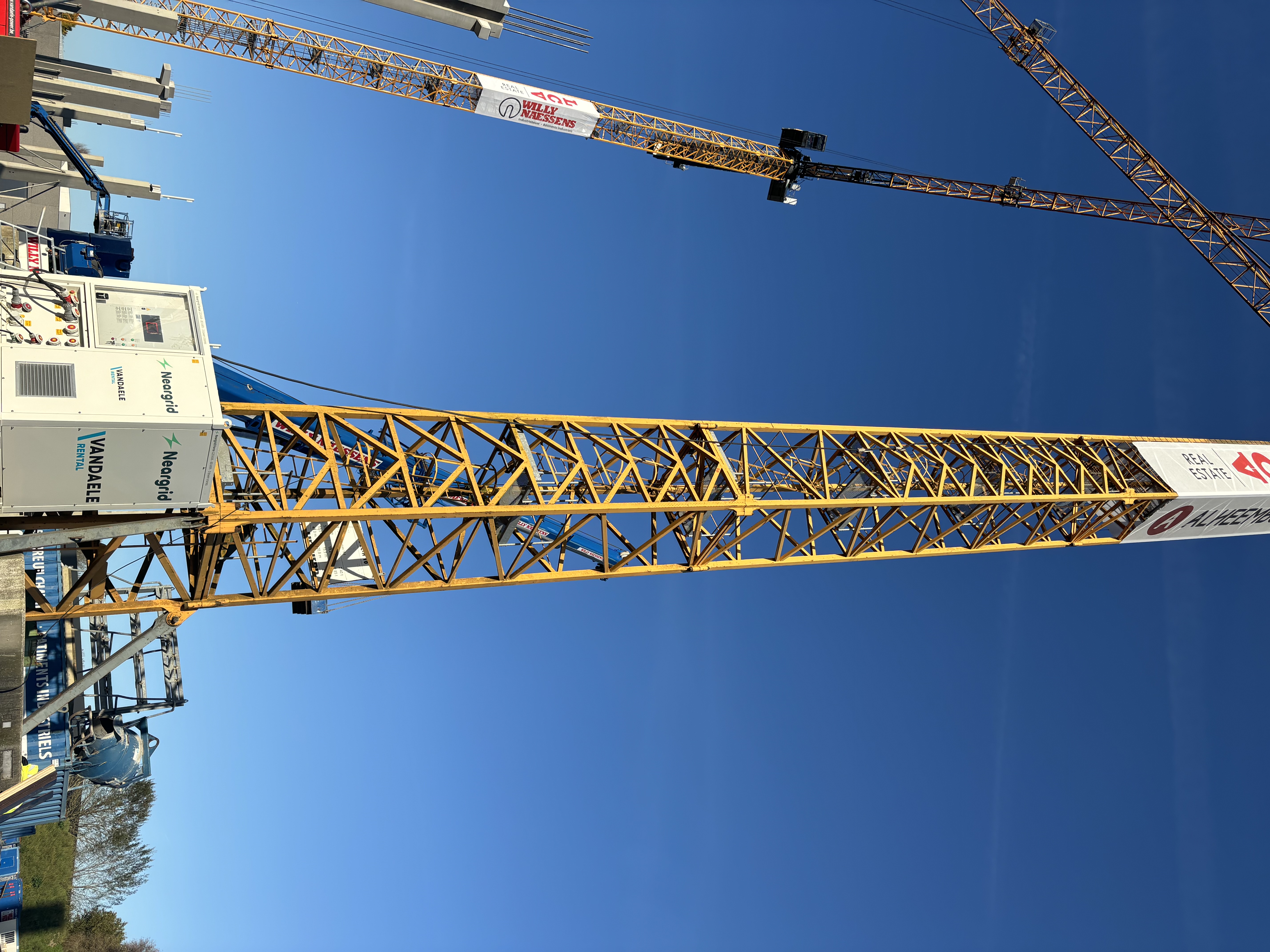
- Tower cranes are a fixed component in your projects
- Your equipment service actively manages energy consumption
- You want to minimize your failure costs
With structural use, a battery becomes an asset rather than an expense.
Advantages of buying
- Lower total cost across multiple projects
- Complete control over deployment and planning
- Reusable across yards
- Strategic advantage in tenders
Important: a battery system pays for itself not only in terms of energy, but above all in terms of:
- Avoided downtime
- Lower grid connection
- No diesel, no maintenance, no sabotage
What is often forgotten
Buying a battery is not like "putting a box on the yard."
What really matters:
- Advance energy planning
- Correct dimensioning (power ≠ capacity)
- Monitoring during the project
- Support in case of malfunctions
Without those elements, a battery becomes a risk.
With those elements, it becomes a security buffer.
The practice: why most contractors start out hybrid
In reality, we see this pattern:
- First projects → rent
- Gaining insight into consumption, peaks, and autonomy
- Recognizing repeatability
- Switch to purchase or operating lease
That makes sense.
Electrification is not a leap, but a controlled transition.
Cost comparison: battery vs. diesel (short and sharp)
What surprises many contractors:
- Dieselgeneratoren hebben <5% efficiëntie
- Fuel + maintenance + rent continue every day
- Downtime costs are often higher than energy costs.
In practice, it appears that:
For a single long-term project, a battery system is often already cheaper than diesel.
For multiple projects, the difference is structural.
That is why more and more contractors today are calculating TCO rather than daily rates.
What Neargrid does differently (and why it matters)
Whether you rent or buy: the system must be right.
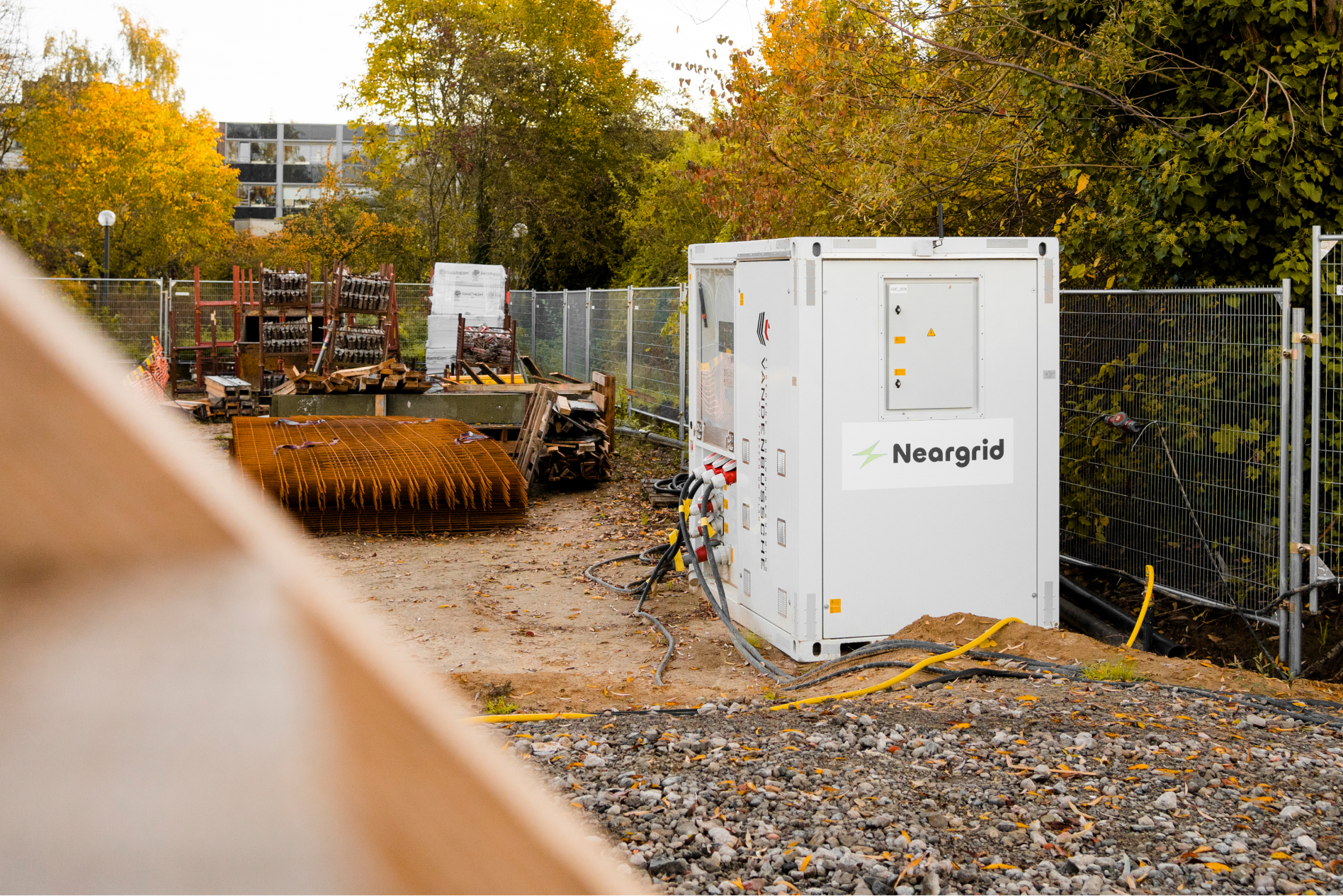
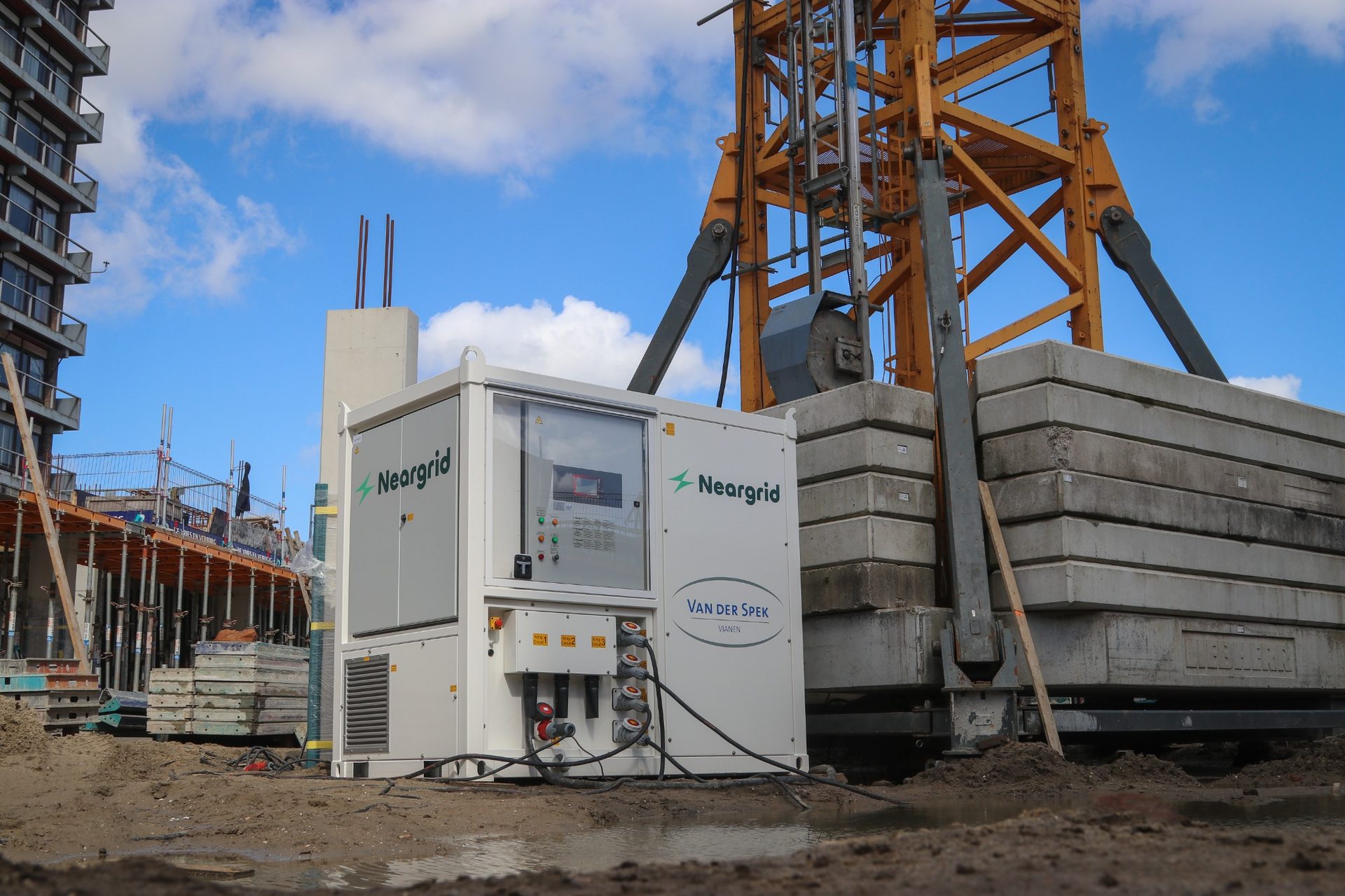
Neargrid is not just a "battery," but a complete energy system for the construction site:
- Designed for tower cranes (peak capacity, stability)
- Works with limited mains connection (e.g., 32A–63A)
- Forms a stable microgrid on the construction site
- Continues to run during power failure (buffer ≥ 4 hours)
- Quiet, emission-free, and resistant to sabotage/theft
More importantly:
Neargrid thinks along with you before, during, and after the project.
That makes renting safe.
And buying profitable.
So: buy or rent?
In summary
Rent as:
- you want to start without risk
- these are temporary projects
- speed is more important than optimization
Purchase (or lease) as:
- you electrify structurally
- you want to limit your failure costs
- you want to manage your energy strategically
Next step: have it calculated for your site
Every construction site is different.
Consumption, peaks, grid connection, and runtime determine everything.
That's why we don't start with a quote, but with insight.
Have your site analyzed without obligation
Do you use tower cranes on your construction site?
→ Send us your site details and we will provide a free analysis of all your energy consumption in an energy planner.
Schedule a free energy scan: click here
Contact us for a consultation
Calculate your TCO compared to diesel
Calculate your savings in 1 minute
Compare directly: Start your calculation
1. Your savings compared to a heavy wholesale connection (CAPEX + fixed charges + connection costs) : Start your savings calculation
2. Your savings compared to diesel generators (fuel, rental, maintenance, downtime) : Start your savings calculation
Find out whether renting or buying makes sense for you
Carefree construction starts with a reliable power supply.
The rest will follow naturally.
Do you have questions about the total cost or maintenance of battery systems?
Our FAQ provides clear answers to the most frequently asked questions.