.png)
CO₂-Performanceladder for construction: emission-free construction power as #1 measure

CO₂ reduction increasingly determines who gets the award , This is how the CO₂ Performance Ladder works for construction companies
The Dutch construction industry is rapidly shifting toward emission-free work. Not because of buzzwords, but because CO₂ reduction now directly determines who gets the award. Whereas the CO₂-Performanceladder was still a nice bonus a few years ago, we now see that for class 7-8 contractors it is literally the deciding factor in tenders.
In this article you will read:
- How the CO₂-Performanceladder works,
- Why diesel generators are your biggest bottleneck,
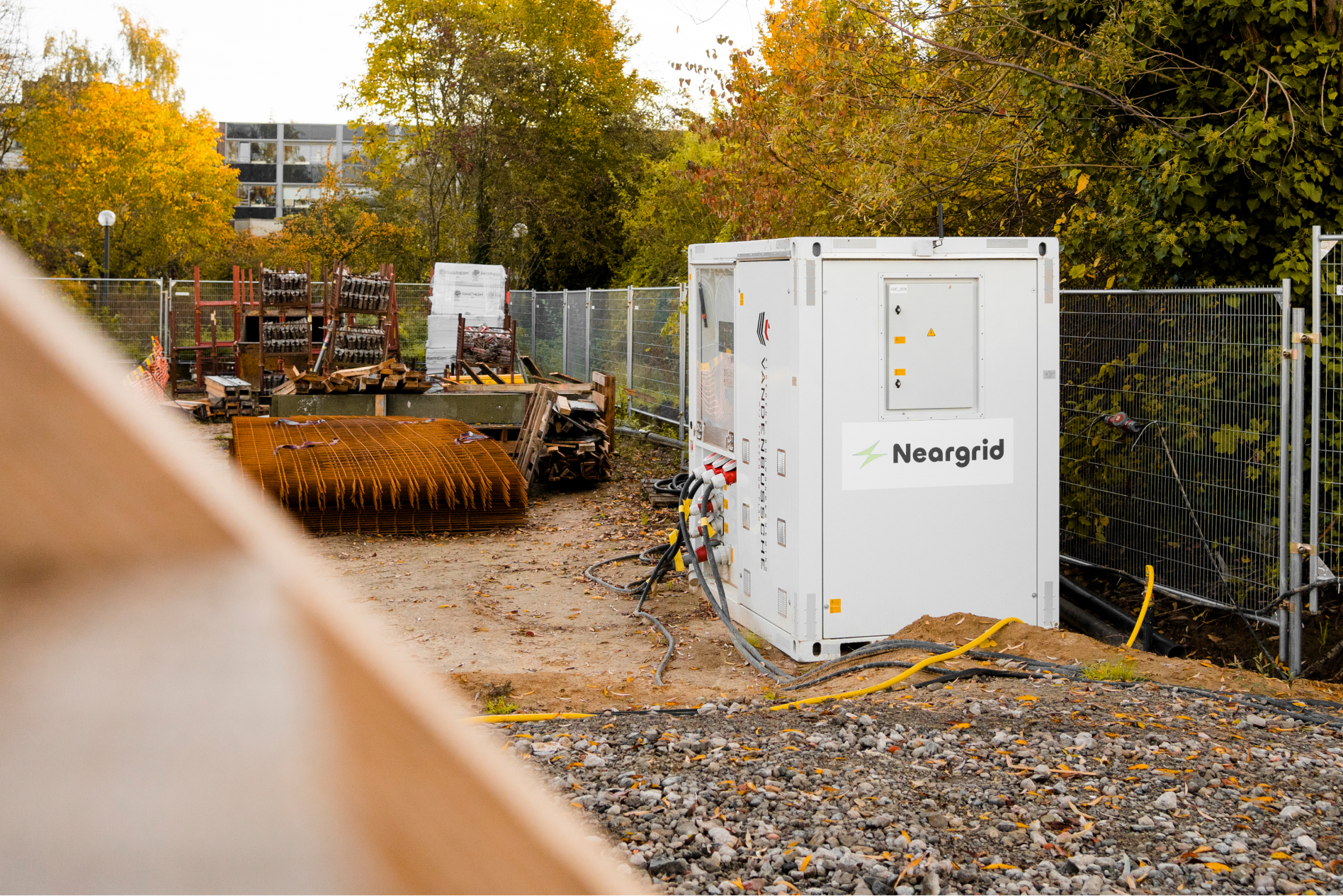
- and why zero-emission battery systems for construction are now the most effective, directly measurable measure for CO₂ reduction.
What is the CO₂-Performanceladder?
SKAO's CO₂-Performanceladder is the main instrument by which clients assess how seriously construction companies are dealing with CO₂ emissions. The Ladder directly affects:
- your EMVI score,
- Your position in tenders,
- and your award chances.
Many commissioning authorities (Department of Public Works, provinces, municipalities, large infrastructure parties) are applying the Ladder more and more strictly. Companies with realistic, high-impact measures score higher and get an advantage in tenders.
Learn more about our solutions for sustainable construction sites through Neargrid's zero-emission energy systems
How does the audit of the CO₂-Performanceladder work?
An audit focuses on three components:
1. Actual emissions (Scope 1 & 2).
At typical construction sites, most emissions occur:
- diesel generators,
- machines,
- transportation.
The aggregate in particular is often emission source number one (especially in inner-city projects).
2. Reduction measures
Auditors only assess measures that have real impact. No paper plans, but concrete steps that reduce CO₂.
3. Transparent reporting
Data must be complete, accurate and verifiable. This is where Neargrid systems can help because our units provide verifiable metering data per kWh.
Learn exactly how our Neargrid Compact fits these audit criteria.
Why diesel generators are holding back your carbon score
Diesel generators produce a lot of emissions (CO₂, NOx, particulate matter) and run additionally:
- often 95% of the time at part load,
- with high specific emissions per kWh,
- with more noise and disturbance to the surrounding area.
In urban projects, this has a double negative impact: lower carbon score + risk of complaints or shutdown.
This is why the diesel generator is at the top of the list of reduction measures in audits.
Do you have a project with limited grid connection? See how the Neargrid Boost dramatically reduces diesel consumption.
Battery systems: the fastest route to emission-free yard power
More and more construction companies are switching from diesel to emission-free battery power. This is not only better for the environment, it is above all the fastest, most measurable measure for the CO₂ Performance Ladder.
Benefits of Neargrid systems to your carbon score:
- 0 kg of CO₂, NOx & particulate matter per operating hour (at green charging source)
- Immediately measurable reduction for audit and reporting
- Higher EMVI scores through emission-free site flow
- No downtime due to peak power + smart control
- Lower total cost of ownership
- Quiet construction site, without odor nuisance
- For large-scale projects where a lot of power is needed, check out the Neargrid Force
Download Electrification of construction sites e-book
Industry case study
On the House of the City project in Amersfoort, Dura Vermeer worked three tower cranes emission-free, using a battery system as the primary energy source.
Results:
- no diesel,
- no emissions,
- no hindrance,
- no downtime,
- full audit verifiable reduction.
More case studies can be found here
Specifically, what does this measure give you?
1. Instantly higher tender opportunities
Through demonstrable, emission-free yard flow.
2. Lower emissions (effective immediately).
Additional benefit: easier reporting.
3. Strong audit position
Auditors recognize battery deployment as a hard reduction measure.
4. Reduced operational costs
No diesel, less maintenance, more uptime.
5. A future-proof yard
Perfectly suited to zero-emission policies of cities and clients.
Frequently asked questions (FAQ)
1. Is CO₂ reduction mandatory in tenders?
Not by law, but clients do use it as a hard EMVI factor.
No reduction = fewer points.
2. What happens if we don't take action?
You fall behind competitors who do take action.
Lower score, lower award position.
3. Does electrification always count as a reduction measure?
Yes, provided the source is emission-free.
A Neargrid system fully complies with this.
4. What is the fastest measure to audit?
Replacing a diesel generator with a battery system, one of the few measures with directly verifiable impact.
5. Will a battery system fit on any construction site?
In almost all cases.
View solutions by project type:
- Neargrid Compact : quiet, compact, inner-city
- Neargrid Boost : hybrid switching, peak smoothing
- Neargrid Force : greater powers
What other CO₂ measures are construction companies deploying?
Many contractors are working on several measures at once to score higher on the CO₂-Performanceladder. After all, the audit looks at reductions across the entire construction site organization.
Below is an overview of measures that construction companies often implement that will help you move toward a zero-emission construction site, without overlapping with Neargrid solutions.
1. Electrification of equipment
More and more construction sites are switching to electric excavators, shovels and telehandlers.
Note: electric equipment is only truly emission-free if the power source is too. That makes the move to battery power logical and audit-worthy.
2. Optimizing transportation & logistics
CO₂ reduction is achieved by:
combining rides,
deployment of electric vans,
more efficient route planning.
Good for CO₂ as well as costs.
3. Energy-efficient construction site design
Reduced consumption by:
LED lighting,
switching times,
sensors.
Small measure, but visible in Scope 2.
4. Facilities on green power
A green power contract or green grid connection directly reduces the CO₂ intensity of the yard.
In combination with a battery system, this works out to 0 kg of CO₂ per kWh.
5. Temporary solar panels on construction sites.
More and more companies are installing temporary panels for:
charging support,
lighting,
kitchen units.
Combined with the Neargrid Compact of Force, this energy is efficiently stored and utilized.
6. Heat pumps instead of diesel heating.
This reduces NOx, CO₂ and odor pollution. Especially relevant in winter projects.
7. Circular & biobased materials
A structural measure that counts especially at levels 4-5 of the Performance Ladder.
8. Monitoring and data-driven CO₂ steering.
Auditors appreciate clear numbers. Use of monitoring software or sensors makes reports more realistic.
Neargrid systems provide automatic insight into consumption and emission savings, audit-worthy.
9. Staff awareness & training.
More efficient use of machinery, fewer unnecessary running hours and better loading behavior are proven to help with reductions.
10. Chain collaboration (required for level 4-5).
Working with suppliers and subcontractors around CO₂ reduction is a plus in audits.
Why emission-free yard power still remains the fastest CO₂ gain
All of these measures help, but they vary widely in impact, cost and lead time.
What auditors and clients confirm:
- Removing a diesel generator and switching to zero-emission power provides the greatest direct carbon reduction.
- It is the most audit-friendly measure: measurable, verifiable and easy to prove.
Ready to improve your CO₂ score and award chances?
Contact us for a consultation
Or read on in our blog section
for more insights on sustainable yard energy.
Recommendedsources & official guidelines
- SKAO - About the CO₂-Performanceladder
https://www.co2-prestatieladder.nl/over-skao/ - RFO - Laws and regulations for building sustainability
https://www.rvo.nl/onderwerpen/wetten-en-regels-gebouwen - Central government - First step toward emission-free buildings (EPBD Directive)
https://www.rijksoverheid.nl/actueel/nieuws/2025/07/15/eerste-stap-naar-emissievrije-gebouwen-volgens-europese-richtlijn
Curious what Neargrid means for your construction site?
Calculate your savings in 1 minute
Compare directly: Start your calculation
1. Your savings compared to a heavy wholesale connection (CAPEX + fixed charges + connection costs) : Start your savings calculation
2. Your savings compared to diesel generators (fuel, rental, maintenance, downtime) : Start your savings calculation
Compare with wholesale and diesel and find out immediately your profit in euros and CO₂.
Related articles
Peak power tower cranes : this is how to work emission-free without grid problems
Projects: Ghent University Hospital, Royers Lock, Dijon