Vandenbussche and Neargrid: How a Construction Company Helped Develop the Mobile Construction Site Battery—Six Years of Collaboration

Six years ago, the construction company Vandenbussche asked itself a simple question: Does a construction site really have to run on diesel? The answer led to a long-term partnership with Neargrid, with the first project yielding a calculated 74% savings in primary energy. Jürgen Vanhee, Senior Technical & Quality Manager at Vandenbussche, looks back.
Back when most construction companies were still using standard diesel generators, Vandenbussche asked himself a simple question: Is this really the only solution? Six years ago, at a construction site in Gentbrugge, a quest began that would evolve into a long-term partnership with Neargrid and a fundamentally different approach to on-site energy.
It was 2019. Three tower cranes were in operation on the Rute project, each with its own diesel generator. Vandenbussche had the power consumption of one of those generators measured. The result was striking: the crane only requires a large amount of power for a short time during lifting operations. In between, it consumes much less, but the large generator continued to run all day long.
This led to a logical question: Is there a smarter way? Can a shipyard handle short-term spikes in demand without running a heavy generator all day, or without requesting a grid connection that’s far too large?


Two partners, each with their own strengths
Vandenbussche is a family-owned Belgian construction company based in Aalter, certified in Class 8. Among other things, it builds residential projects, schools, healthcare facilities, and public buildings. Sustainable business practices are a conscious choice for the company: Vandenbussche seeks ways to minimize the impact of its construction sites on the climate, the neighborhood, and the people working there. In doing so, the company uses its technical expertise to test new solutions in real-world conditions.
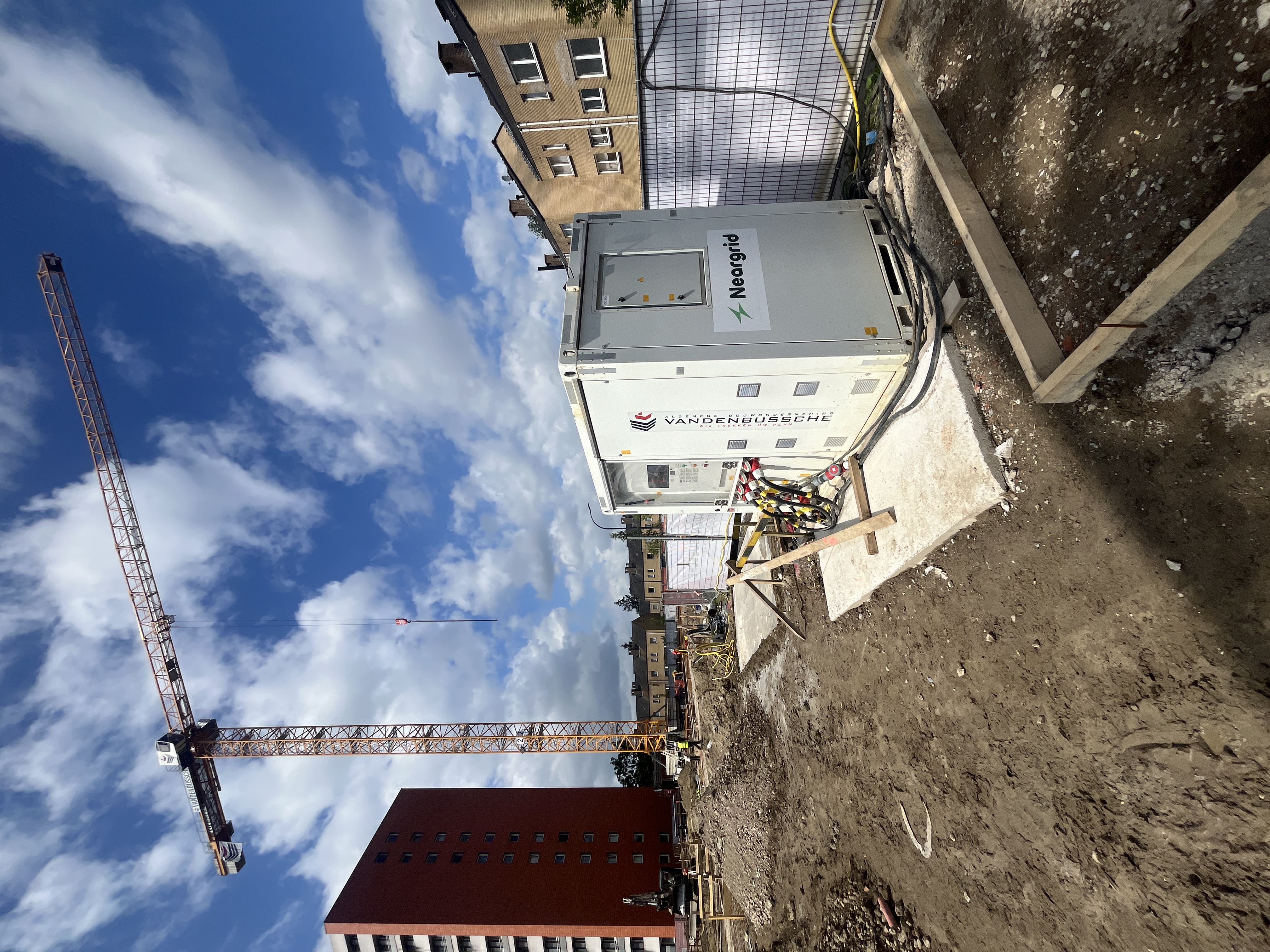
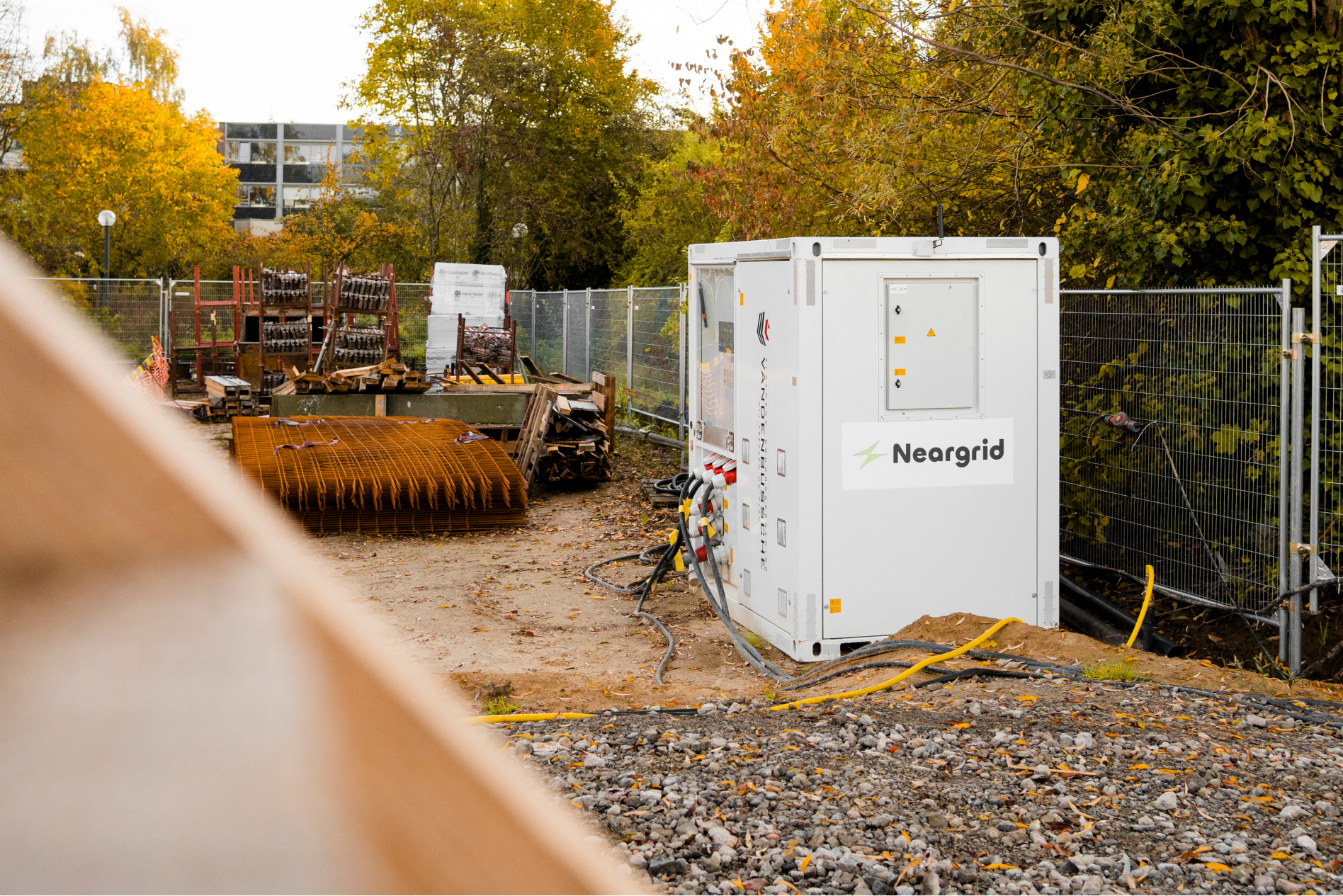
Neargrid ( that’s us) designs and builds mobile battery systems for construction sites. Our systems handle the power spikes from tower cranes and other heavy-duty equipment, allowing a construction site to operate with a smaller grid connection or a much smaller generator. Smart energy management and remote monitoring ensure that power is always available on the construction site.
Together, we combined construction expertise and technology: Vandenbussche knew what a construction site needed, and Neargrid turned that into a working solution.
More than just a customer: helping to build the foundation
Vandenbussche didn't stop at that question in Gentbrugge. The construction company became Neargrid's first pilot client and helped develop the solution from the very beginning.
Vandenbussche’s engineers and construction site teams provided what no lab can: real measurement data, practical experience, and a clear understanding of what a construction site needs. Together with Neargrid, they defined the requirements: what the maximum power connection should be, what power peaks the cranes require, how transportation works, how to start up safely, and how to monitor everything remotely.
Following initial tests with a prototype in 2019 and 2020, the first system was put into service in 2020 at the Kloosterhof project in Stekene. Vandenbussche took the risk of being the first to deploy a new, unproven product on an actual construction site. Based on its initial experience, the company quickly ordered additional systems.
The results: a 74% reduction in primary energy consumption compared to a baseline scenario using diesel generators
The results were striking. For the first project, a 74% reduction in primary energy consumption was calculated compared to a conventional solution using diesel generators. That figure applies to the specific conditions of that project and is therefore not a guarantee for every construction site.
Vandenbussche also noticed the difference at the shipyard itself:
- Reliable power for high-demand equipment such as tower cranes
- Less noise and no exhaust fumes on site
- Less diesel transportation and less maintenance
- A smoother start to the construction project
- Quick help: Neargrid's service team is almost always available and resolves many issues remotely right away
"What began as a measurement campaign at a construction site with three tower cranes in Gentbrugge evolved into a fundamentally different perspective on construction site energy," says Jürgen Vanhee. "By combining our technical knowledge of construction sites with the development of Neargrid, we were able to demonstrate that high-power construction site equipment can be powered by a low-voltage connection."

How does it work?
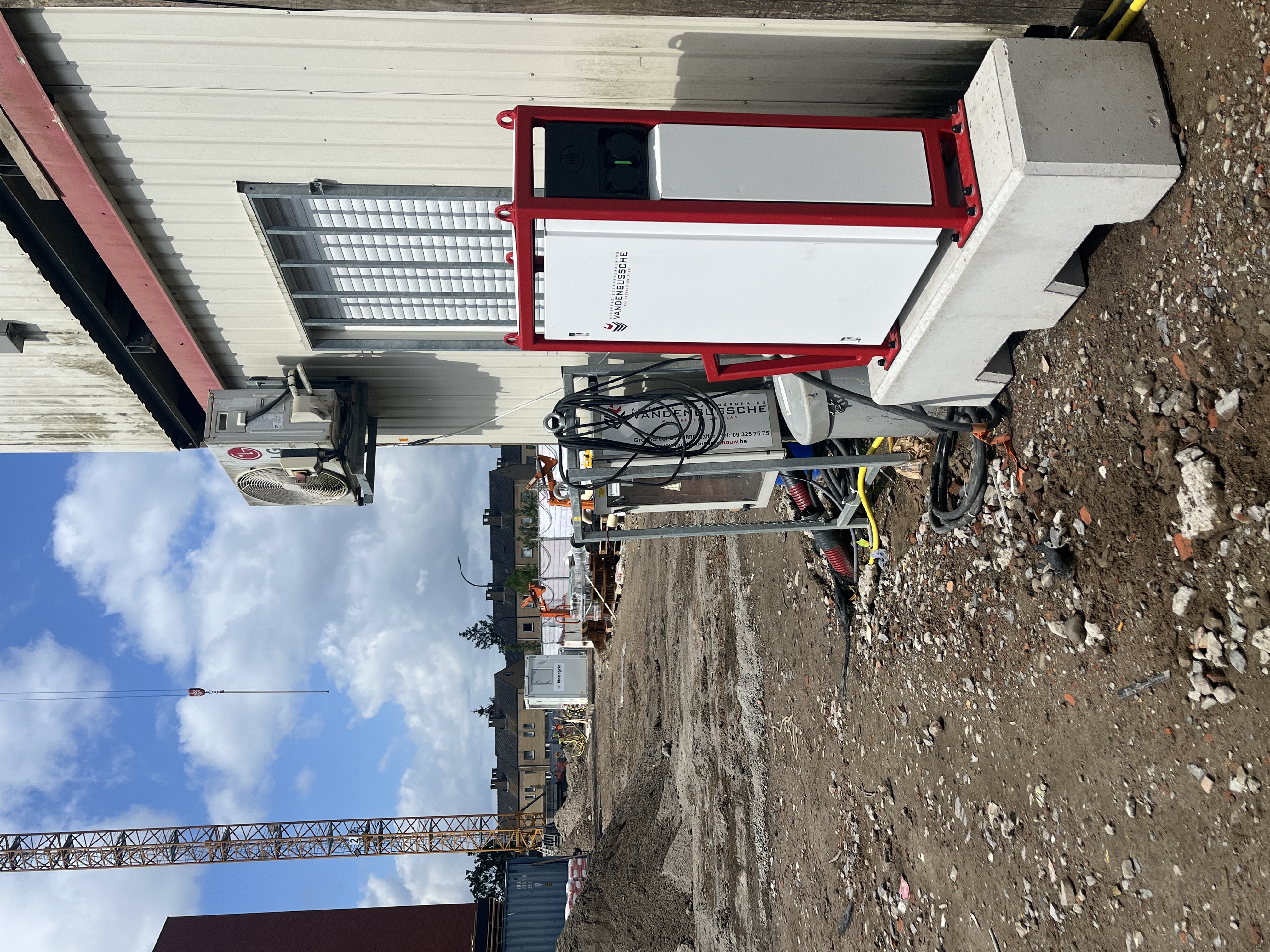
The idea is simple. A tower crane only requires a brief surge of power during lifting operations. The battery provides that surge. Between lifting operations, it quietly recharges via a smaller grid connection, and in the meantime, it also powers the rest of the construction site: the site trailer, lighting, and site cabinets.
However, it’s important to note that every job site is different. Pumps that run all day, cable lengths, working hours, and the available power connection all play a role in determining the right setup. That’s why every project starts with the same step as in Gentbrugge: first, assessing what the job site actually needs.
Innovation happens on the construction site
"Innovation doesn't happen behind a desk, but on the construction site. By combining technical expertise with practical experience, Vandenbussche continues to seek ways to build smarter, more efficiently, and more sustainably. The partnership with Neargrid is a tangible and powerful example of this," says Vandenbussche.
For us, Vandenbussche’s story is the starting point for everything that followed. Without a contractor who dared to think along with us and experiment, Neargrid wouldn’t be where we are today. Now that we’re also working with contractors in France, Ireland, the UK, and Germany, we’re taking that same approach: first understand the job site, then tailor the power supply to it.
Are you planning a project that involves tower cranes and has limited access to the power grid?
Please provide us with the site layout, the available power connections, and the power ratings of your equipment. Our team will be happy to determine which solution is best suited for your project.
More Projects in the Spotlight
Kloosterhof residential project
Learn more about this project at Vandenbussche